
Cell Division
Contents for Tables:-
-
- Introduction
-
- Cell Cycle
-
- Cell Cycle Definition
-
- Phases of Cell Cycle
-
- Types of Cell Division
-
- Mitosis
-
- Meiosis
-
- Types of Cell Division
-
- Conclusion
Introduction
Cell division is a highly regulated and carefully orchestrated process. Understanding the mechanisms that promote proper cell division is an important step toward unraveling important questions in cell biology and human health. Early studies seeking to dissect the mechanisms of cell division used classical genetics approaches to identify genes involved in mitosis and deployed biochemical approaches to isolate and identify proteins critical for cell division. These studies underscored that post-translational modifications and cyclin–kinase complexes play roles at the heart of the cell division program. Modern approaches for examining the mechanisms of cell division, including the use of high-throughput methods to study the effects of RNAi, cDNA, and chemical libraries, have evolved to encompass a larger biological and chemical space. Here, we outline some of the classical studies that established a foundation for the field and provide an overview of recent approaches that have advanced the study of cell division.
Cell division, or mitosis, is the process by which a mother cell divides its nuclear and cytoplasmic components into two daughter cells. Mitosis is divided into four major phases: prophase, metaphase, anaphase, and telophase. Careful regulation of the cell division program is crucial for proper cell growth, development, and gametogenesis. Dysfunction or misregulation of cell division can lead to growth defects and proliferative diseases like cancer and aging-related diseases , including Alzheimer’s disease. Therefore, analyses of the pathways and mechanisms that promote proper cell division are important avenues through which we can understand cell regulation and its misregulation in human disease.
Cell division is driven by two main modes of post-translational modifications. First, protein kinases like cyclin-dependent kinases (CDKs) and Polo-like kinases phosphorylate their substrates to modify their activity or stability; this modification is opposed by protein phosphatase–mediated dephosphorylation (for example, Cdc25 and various PP2A complexes). Second, E3 ubiquitin ligases like the anaphase-promoting complex/cyclosome (APC/C) and Cullin 1-based SCF (Skp-Cullin-F box) complexes ubiquitylate their substrates and target them for proteasomal degradation; this modification is opposed by deubiquitylases such as USP37 and Cezanne . Spatiotemporal control of when these post-translational modifications occur gives rise to the ordered events of cell division. Our current understanding of key regulators of cell division is founded upon many classical genetic and biochemical studies aimed at understanding the cell cycle. We begin by highlighting some of these seminal studies, transition to discussing modern techniques and approaches used to dissect the mechanisms of cell division, and conclude with future directions and perspectives on the cell division field.
Cell Cycle
The cell is the basic structural and functional unit of any living being. It is the fundamental building block, which when combined with similar cells forms a tissue and organs. A cell comprises several organelles:
-
- Cytoplasm
-
- Cytoskeleton
-
- Endoplasmic reticulum (ER)
-
- Golgi apparatus
-
- Lysosomes and peroxisomes
-
- Mitochondria
-
- Nucleus
-
- Plasma membrane
-
- Ribosomes
The cell undergoes a series of events that result in the duplication of cell along with the DNA. This is known as the cell cycle. Let us have a look at the events taking place in the division of cell during a cell cycle.
Cell Cycle Definition
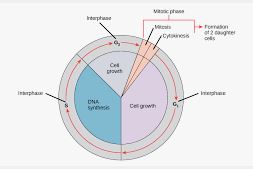
“Cell cycle refers to the series of events that take place in a cell, resulting in the duplication of DNA and division of cytoplasm and organelles to produce two daughter cells.”
What is Cell Cycle?
The cell cycle was discovered by Prevost and Dumas (1824) while studying the cleavage of zygote of Frog. It is a series of stages a cell passes through, to divide and produce new cells.
This entire process where with the help of one single parent cell a new cell population grows and develops is known as the cell cycle.
Phases of Cell Cycle
Cell cycle or cell division refers to the series of events that take place in a cell leading to its maturity and subsequent division. These events include duplication of its genome and synthesis of the cell organelles followed by division of the cytoplasm.
Human cells exhibit typical eukaryotic cell cycle and take around 24 hours to complete one cycle of growth and division. The duration of the cycle, however, varies from organism to organism and cell to cell.
A typical eukaryotic cell cycle is divided into two main phases:-
Interphase
Also known as the resting phase of the cell cycle; interphase is the time during which the cell prepares for division by undergoing both cell growth and DNA replication. It occupies around 95% time of the overall cycle. The interphase is divided into three phases:-
-
- G1 phase (Gap 1) – G1 phase is the phase of the cell between mitosis and initiation of replication of the genetic material of the cell. During this phase, the cell is metabolically active and continues to grow without replicating its DNA.
-
- S phase (Synthesis) – DNA replication takes place during this phase. If the initial quantity of DNA in the cell is denoted as 2N, then after replication it becomes 4N. However the number of chromosomes does not vary, viz., if the number of chromosomes during G1 phase was 2n, it will remain 2n at the end of S phase. The centriole also divides into two centriole pairs in the cells which contain centriole.
-
- G2 phase (Gap 2) –During this phase, the RNA, proteins, other macromolecules required for multiplication of cell organelles, spindle formation, and cell growth are produced as the cell prepares to go into the mitotic phase.
Some cells like cardiac cells in the adult animals do not exhibit division and some others only divide to replace those cells which have been either damaged or lost due to cell death. Such cells which do not divide further attain an inactive G0 phase also known as quiescent phase after they exit the G1 phase. These cells remain metabolically active but do not divide unless called upon to do so.
M phase
This is the mitotic phase or the phase of the equational division as the cell undergoes a complete reorganization to give birth to a progeny that has the same number of chromosomes as the parent cell. The other organelles are also divided equally by the process of cytokinesis which is preceded by mitotic nuclear division. The mitotic phase is divided into four overlapping stages:-
-
- Prophase,
-
- Metaphase,
-
- Anaphase, and
-
- Telophase
Types of Cell Division
Cell division is the process in which a cell duplicates itself by dividing its genetic material. For prokaryotes, this process follows simple binary fission in reproduction. In a eukaryotic cell, division for sexual reproduction or vegetative growth occurs through a process involving the replication of DNA, followed by two rounds of division without an intervening round of DNA replication. Students can understand different types of cell division at the organelle level by learning about the appearance of each organelle during interphase and prophase. Our experts at Vedantu have covered everything about cell division for Class 11 students, be it different types of mitosis, meiosis, or any other forms of cell division that you would need to know about.
The two well-documented types of cell division are:
1 .Mitosis
2. Meiosis
Mitosis
Cell division is the driving process of reproduction at the cellular level. Most eukaryotic cells divide in a manner where the ploidy or the number of chromosomes remains the same, except in the case of germ cells where the number of chromosomes is halved.
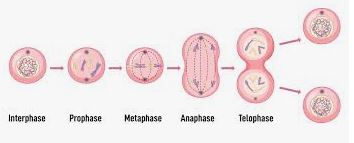
Mitosis is the phase of the cell cycle where the nucleus of a cell is divided into two nuclei with an equal amount of genetic material in both the daughter nuclei. It succeeds the G2 phase and is succeeded by cytoplasmic division after the separation of the nucleus.
Mitosis is essential for the growth of the cells and the replacement of worn-out cells. Abnormalities during mitosis may alter the DNA, resulting in genetic disorders.
2. Meiosis
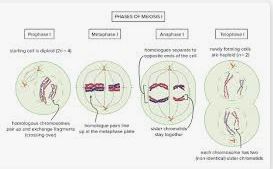
Meiosis is the process in which a single cell divides twice to form four haploid daughter cells. These cells are the gametes – sperms in males and egg in females. The process of meiosis is divided into 2 stages. Each stage is subdivided into several phases.
Mitosis is the phase of the cell cycle where the nucleus of a cell is divided into two nuclei with an equal amount of genetic material in both the daughter nuclei. It succeeds the G2 phase and is succeeded by cytoplasmic division after the separation of the nucleus.
Mitosis is essential for the growth of the cells and the replacement of worn-out cells. Abnormalities during mitosis may alter the DNA, resulting in genetic disorders.
Conclusion
Cell Division can be simply defined as the process that results in two daughter cells, each with the same number of chromosomes as the parent cell. The chromosomes are duplicated first, and then the cell divides. In prokaryotes, binary fission is a simple duplication of the DNA followed by division into two cells. For eukaryotes, the process of cell division is more complicated. The first step in cell division for most cells is the duplication of the chromosomes. A single set of chromosomes in a normal human cell contains approximately three billion base pairs or six billion nucleotides.
In meiosis, I, the sister chromatids of the cell stay together. When the cells divide, it forms four new cells, with a haploid set of chromosomes. In males, all four cells are sperm cells. One new is an egg cell in females, and the others are polar bodies. So, meiosis is important in the process of sexual reproduction. One should know that meiosis II is complete and the cells divide into four new daughter cells.
Methods to dissect the mechanisms that govern cell division have progressed rapidly over the last few decades. The strategies discussed here allow for a genome- or proteome-wide assessment of proteins, drugs, and small molecules involved in cell division. In addition, advances in structural biology and computation have aided the study of cell division, particularly with regard to complex structures that are difficult to study with traditional biochemical techniques. Altogether, these approaches have allowed for the discovery and study of the ensemble of proteins and other factors necessary for proper cell division.
Cell division is a critical process
Cell division is a vital process in all living organisms. For example, when you fall and damage your skin, cell division replaces the damaged cells with new ones, allowing your skin to heal.
There are different types of cell division
There are three main types of cell division: binary fission, mitosis, and meiosis. Binary fission occurs in prokaryotic cells, while mitosis and meiosis occur in eukaryotic cells.
Mitosis is the most common type of cell division
Mitosis is the most common type of cell division and is important for growth and repair.
Mitosis is a multistep process
Mitosis is a multistep process that involves the condensation of cell chromosomes, the assembly of a spindle, and the movement of duplicated chromosomes to opposite poles of the cell.
Click for further information
https://a-zstudentpdfprojectfilesolutions.com/blog/