
A Study for Human Resource Development in Higher Education Institutional
Contents for Tables:-
- Introduction
- Definition of Human Resource
- Types of Human Resource
- Function and Activities of Human Recourse Development
- The Goal of organizational Development
- The Role of Human Resource
- Role of HR in Higher Education
- Conclusion
Introduction
The development of human resource has become a pivotal strategy of organizations to make their employees adaptive to a changing environment. Fast-paced changes in tasks, tools and technologies create a working world in which a basic education or one-time training is replaced by a constant updating of skills. These circumstances urge employees to become lifelong learners. Even entire organizations embrace lifelong learning as their new philosophy and transform into so-called, learning organization.
Also, Higher Education Institutions (HEIs) undergo fundamental changes due to globalization, growing competition for funding and staff as well as increasing institutional autonomy. These changes are linked to new responsibilities requiring greater managerial and leadership competences (Pellert 2007). Especially the university’s responsibility towards its employees has changed – from simply administering to managing staff. In order to successfully adapt to this institutional shift and become more competitive in a complex environment, more and more HEIs adopt different strategies to better deploy their human resource. In view the fact that the investment for employees accounts for the largest share of university expenditure, human resource is the most valuable asset of HEIs and gains in importance in university affairs (Evans & Chun 2012).
The following paper focuses on human resource development (HRD) activities in higher education. The paper consists of two parts each highlighting a different aspect of HRD. The first one focuses on the narrow and more commonly used meaning of HRD relating to the measurements an organization undertakes to develop their staff. Within this part the definition of the term HRD and the challenges of establishing HRD strategies in universities will be discussed. According to the authors’ view a limitation to the conventional understanding of HRD as staff development falls too short in the context of universities. Therefore, the second part of this paper proposes an extension of the meaning and use of HRD within universities by taking into account also the development of students.
The National Policy on Education (NAPE) 1986 in its Program me of Action made a focused reference to the crucial dependence of quality ensured delivery of education to continuous knowledge up-gradation, capacity building and motivation of teachers for accepting challenges arising from exponential growth of new knowledge and fast growing trends of breaking barriers of subject specific teaching and research. Thus, the NAPE recognized the urgent need for creating effective systems to provide opportunities for professional and career development of teachers, necessary for quality education and research so that they are well equipped and motivated to accept new challenges emerging from growth of new knowledge, international competitiveness and changing requirements of learners, especially in the institutions of higher education. Therefore, it was proposed to enhance their motivation skills and knowledge through systematic orientation in specific subjects, techniques and methodologies, and thereby inculcate in them the right kind of values that would in turn encourage them to take initiatives for innovative and creative work. In order to achieve the above objectives, an initiative was taken by University Grants Commission in the year 1986 and over a period of time, 66 Academic Staff Colleges (ABCs) were established in different universities. During the last two decades or more, the system of ABCs has come to be accepted well and established in the university system with plan to plan financial support of the UGC and cooperation extended by the universities in providing basic infrastructure and other support, required for functioning of the ABCs.
Definition of Human Resource
There are various definitions of HRD, which differ in focus, purpose and goals according to the context. Despite numerous attempts in literature to define HRD, a consensus on a specific definition does not exist. However, two strands of definitions can be identified: one referring to a broader and the other to a narrower understanding of HRD. In the broad sense HRD seeks to develop people’s “knowledge, expertise, productivity and satisfaction, whether for personal or group/ team gain, or for the benefit of an organisation, community, nation, or ultimately, the whole of humanity.” (McLean & McLean 2001).
In the narrow sense HRD is used as a generic term for systematic and planned activities implemented by an organization to enhance the professional qualifications of its employees with regard to the objectives of the organisation. This interpretation of HRD is usually equated with Training and Development and forms the most widely practiced one within organisations (O’Donnell, McGuire & Cross 2006).
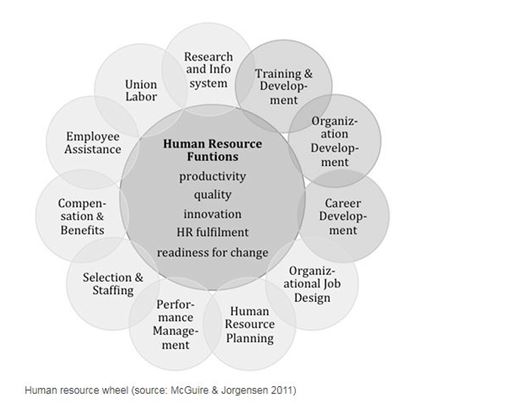
Apart from the different understandings of HRD there is also confusion over the boundaries delineating Human Resource Development from Human Resource Management (HRM). The terms HRM and HRD are often used interchangeably, both in theory and practice (O’Donnell, McGuire & Cross 2006). Usually, however, HRD is considered a subset of HRM. In order to make a clearer distinction between these two terms, McLagan (1989) has delineated the various dimensions and functions of both in the so-called “human resource wheel”. The functions of HRD depicted in the wheel can also be found in the most popular among the definitions of HRD, defining it as “the integrated use of training and development, organization development, and career development to improve individual, group and organizational effectiveness.” (McLagan 1989).
Types of Human Resource
There are numerous important human resources functions carried out by an HR department. Five well-known types of responsibilities are:
- Recruiting, hiring, and onboarding new employees
- Handling employee compensation and benefits
- Offering employee job/career development
- Addressing work-related issues of individual employees
- Developing policies that affect a working environment company-wide
Function and Activities of Human Recourse Development
According to McLagan’s human resource wheel, HRD comprises three distinct functions: training and development, organization development and career development.
Activities
A human resources manager can have various functions in a company, including to:
- Determine the needs of the staff/personnel.
- Determine whether to use temporary staff or hire employees to fill these needs.
- Determine do’s and don’ts.
- Train and develop management styles
- Recruit and/or interview the best employees
- Train employees and upgrade their learning knowledge
- Supervise the work
- Evaluate the work
- Establish discipline work culture in the organization
- Avoid politics in the office.
- Apply HR software for the ease of work in the organization.
- Manage employee relations. If there are unions, perform collective bargaining
- Prepare employee records and personal policies.
- Manage employee payroll, benefits, and compensation
- Ensure equal opportunities
- Deal with discrimination
- Deal with performance issues
- Prepare remote work and hybrid work policy
- Ensure that human resources practices conform to various regulations
- Motivate employees
- Mediate disputes
- Disseminate information in the organization so as to benefit its growth
Managers need to develop their interpersonal skills to be effective. Organizational behavior focuses on how to improve factors that make organizations more effective.
Training and Development
Training refers to reactive and short-term activities that focus on changing or improving knowledge, skills or attitudes of individuals to perform a particular job or task. These activities mostly comprise skills, which are immediately needed and have an immediate benefit, whereas development activities concentrate on new skills and abilities aiming for future job opportunities. Usually Training and Development (T&D) measures comprise three major competence areas:
- methodological competence (teaching, administration, IT- Systems, Finance, Legal know-how, Safety and Security, etc.)
- self-confidence and social competence (personality and soft skills, Time management, Work-Life Balance, languages, etc.)
- management competence (Leadership development, project management, etc.)
Another effective T&D tool regards employee orientation or induction, where a new employee learns about the organizational values, norms and tasks. The induction of new employees includes activities such as:
- the mentoring by a colleague of the same hierarchy level that cares for the new colleague and is responsible for his/her integration or
- a well defined induction program for the first months of employment or
- simply an “employee handbook” to facilitate the orientation.
Furthermore, various individual measures such as on-the-job training, mediation, mentoring, coaching and counselling for organisational units, project groups or individuals are included in T&D actions. While coaching refers to activities where employees are treated as partners in achieving both personal and organizational goals, counselling supports employees to deal with personal problems that could prevent them to achieve these goals (Böckelmann, Reif, Fröhlich 2010; Werner & DeSimone 2012).
Organization development
The second functional area of HRD refers explicitly to the development of the organization. Its purpose is to improve the relationships and processes between and among units, groups and individuals. Organizational development activities relate more to long-term strategies aiming for a holistic development of the organization in order to increase its overall efficiency (Werner & DeSimone 2012).
The Goal of organizational Development
We already touched briefly on the goals of organizational development. These goals vary between organizations. In corporate companies, increasing profits is likely to be a chief concern. Within charities, the cultural values are of high importance. And in health services, adaptability is central to maintaining good functioning.
If there would be one central goal, it would be increasing the organization’s competitiveness.
Competitiveness is the idea that every organization has unique resources and competencies that help the firms to win in the marketplace. This can be the people (a business leader like Elon Musk, or the Google team), an innovative product (SpaceX), superior service (Four Seasons Hotels), or culture (Zappos). It can also be how reactive the organization is to changing market demands. If you’re the first to capitalize on an opportunity, for instance, it may solidify your revenue in the next five years.
The goal of OD is to develop these aspects, as they can help a business win in the marketplace.
This means that organizational development differs from the incidental change process. OD focuses on building the organization’s ability to assess its current functioning and tweak it to achieve its goals. It is, therefore, a continuous process, whereas change processes are often temporarily.
This also emphasizes the relevance of OD. In this VUCA world, change is becoming a constant factor. OD is an integral approach to ensuring this constant change.
Career development
Career development includes both career planning and career management. Career planning refers to skills assessment through counsellors, who assist employees in pursuing their career plans. Career management on the other hand is responsible for actually taking the necessary steps to achieve these plans. In the university context the tenure track model is one example of designing adequate career paths for university teachers to eventually obtain a high level of professional stability (Werner & DeSimone 2012).
Ultimately, all HRD measures intend to cause a greater efficiency and effectiveness through fully committed and skilled employees, who perform their work in alignment with the goals of their organization.
The Role of Human Resource
Role of HR in general
Human Resource Management (HRM) is a significant function in a company, and great importance and value are being attached to it in modern management. Today, people are specially trained in this field to meet the increasing demand of HRM responsibility, which includes planning, organizing, staffing, etc. In this regard, HRM is playing and will continue to play a significant role in a company or an institution.
Since the mid-20th century, some companies have outsourced some of the more traditional administrative, transactional HR functions in an effort to free the department to recommend and implement more meaningful, value-adding programs that impact the business in positive ways.5
Functions that may be outsourced in this process include:
- Payroll administration
- Employee benefits
- Recruitment
- Background checks
- Exit interviews
- Risk management
- Dispute resolution
- Safety inspection
- Office policies
Role of HR in Higher Education
There is a very wide range of ways how HRM unit is incorporated and used at any given university. For example, in “very few universities in Central, Southern and Eastern Europe” HRM was established (Böckelmann et al., 2010), while it is much more common to have this unit operating in full force in Western universities (e.g., UK, US). This diversity can be summarized in two somewhat antithetical systems which are mostly common across this spectrum. Each of this model creates a very different outlook of how HRM unit interacts with general management and other academic departments. This classification is not comprehensive, but provides basis for discussion of how HRM unit can evolve from one system to another. Obviously, each system has its own advantages as well as disadvantages and we will mention them only briefly as discussion of those systems may be another chapter in this book.
If we look at Central, Eastern and Southern Europe it is possible to notice that HRM unit as such exists only to supplement function of the university. Usually, this unit is operating only to comply with national and regional labor laws and does not involve itself with business of human resource development or even recruiting. Recruiting is done usually at departmental level and HRM unit is only responsible to enlist this person so that it follows the rules and regulations in place. Disadvantages of this system include reactiveness, as there is no meaningful strategy in place, which means that HRM unit only reacts to external influences. In addition, very low commitment of staff and academics which is not fostered in any meaningful way. For instance, it fosters low level of engagement of staff and academics to institutional mission and goals, and low level of sustainability which means that if university is to operate in more business manner this type of HRM unit won’t be good enough to create sustainable organizations for reasons which were discussed in the introduction. Advantages of this system mainly refer to the fact that this system is seen as traditional which means that top-management does not really see the reason to change it. If changes do happen, they are usually performed with top-down approach which brings whole new set of problems as “street-level bureaucrats” (Lipsky, 1980) often times dilute the change to near nothingness. Interaction of HRM unit in this system with other department and general management is limited to a very narrow range of questions of labor law and regulations in place. For example, one of the authors of this paper has interacted with HRM unit of his Russian university handful of times in almost 3 years of his employment and those interactions were strictly confined to requirements of labor law and regulations at the university.
Second type of system is when HRM unit does exist and it operates independently and reports directly to upper-management (not through financial department). As we have already mentioned, this system is pretty much opposite to the first one in that it has human resource development and sustainable growth of organization as its mission. Recruitment and even head-hunting is common, there is usually some sort of appraisal system which is directly tied to promotions and salary increases, each staff member and academic is aware of institutional mission and is using it in his or her everyday work. Some advantages of such system include high engagement of human resources, high degree of interaction between departments and upper-management. Disadvantage of this system is that it is very difficult to create it and that it requires a lot of work from everyone involved: not only HRM unit, but also staff members, academics, and upper-management. However, such system should be a goal of each university in current world of decreasing public funding and increasing competition. Interaction of HRM unit with academic departments and general management is of central importance as it becomes a facilitator of many changes inside an organization and provides a framework for the whole organization.
In the real world, each university will be some combination of those two systems, but if we are to understand how HRM unit should interact with other departments, the first thing is to define the mission statement and goals of such a unit. Should it be an independent unit? Should it be autonomous? What responsibilities should this unit have? What are the rules of engagements and scope of work for it? (Armstrong, 2003) All these questions (and many others) should be answered in order for HRM unit to be productive. This is not a trivial task, of course, in itself, but it lays foundation for how HRM unit should interact with other departments and what intensity, depth, and breadth this interaction should have.
Another set of dimensions which define how HRM unit interacts with various stakeholders in the university is roles and activities which are performed by HRM. These roles and activities are aligned along three main areas which follow each other in chronological order (Böckelmann et al., 2010): recruit-retain-develop.
- Recruit area generally can be described as everything concerning human resources issues prior to the employment of the individual. It covers not only recruitment per se, but also questions of how many staff members should be employed, what are their responsibilities, gender and minority issues, law compliance, talent management, and so on. Each of this tasks requires various degrees of interaction with other actors in university and it presents HRM unit with opportunities to influence decision-making inside of the university in order for the whole organization to be successful, as well as to create positive image for potential employees.
- Retain area is all about getting the most out of the employees while giving them a chance to realize their potential in professional area. Here we ought to consider both extrinsic and intrinsic motivation of employees (Zaugg et al., 2001).
- With extrinsic motivation HRM unit is in charge of determining the salary of individuals, as well as conditions for salary raise or promotion. Here an important instrument is performance management with what often takes form of performance agreements for each individual. The choice of indicators to be included in those contracts is again more of an art, than strict science since what works in a university down the road may not be applicable to any given university, but those indicators should be aligned with strategic goal of a university (Burke, 2002). In this area, HRM unit has a lot of potential to influence decision-making process as indicators are usually based on top-down process when general management decides on strategic goals, but indicators themselves and how they are measured can be decided by HRM unit in interaction with both general management and academic departments.
- Intrinsic motivation is much more difficult to define and hence to measure. Here HRM unit is in charge of creating an atmosphere where each employee (be it administrative or academic) should maximize his or her potential. It is also important to consider that often relying just on extrinsic motivation may be not sustainable since it might lead to unintended consequences from employees. While extrinsic motivators (e.g. salary) are important to functioning of an organization, it is intrinsic motivators (e.g., self-fulfillment, work-life balance etc) which are usually come to a forefront in a long run (Zaugg et al., 2001). HRM unit should be an active actor in identification and analysis of possible changes in work place (e.g., flexible timetable, possibility to work from home etc.) in order to create sustainable organization.
- Development area is about providing learning opportunities for employees so that they can better themselves. This is mutually rewarding process as employees get the chance to better themselves, while university gets more motivated and educated worker who creates more value. The tools which can be used in this are numerous and, arguably, this is the biggest area for HRM are to be active at university. For instance, organization of seminars, continuous professional education and career planning can be an area where HRM unit interacts most heavily with academic departments and administrative staff.
The role of HRM unit in university can be extremely diverse. With models that we have outlined above its influence on organization can range from minimal to becoming an integral part of an organization. In next chapter, we will show what role exist for HRM units in real world examples, as well as provide some suggestions on how to enhance this role for those universities.
Conclusion
Human Resource Development is very important in today’s world. Investing in human capital is one of the most relevant factors affecting economic growth of a country. Education is the real essence of Human development. Sustained development cannot be achieved without education. Indian Government has taken various steps for Human Resource Development. As a result, progress has been achieved, literacy and GDP has increased but it is not impressive as compared to other developed countries. There are other constraints too such as poverty, low per capita income, disparity of income, rigidity, lack of political support, lack of modern technology etc. if we can take proper initiative to eradicate barriers of HRD we can convert huge population into Assets of the country.
Establishing a boundary or scope for HRD, and particularly IHRD, is controversial—with some arguing that a discipline must have well-established and accepted boundaries, while others argue that ambiguity is desirable in preventing a field from becoming stagnant. The authors of this paper each take one of these positions. Nevertheless, we are in agreement that having a definition, whether accepted or questioned, helps to build a dialogue that helps the field continue to develop. Exploring IHRD provokes HRD scholars to pay more attention to larger issues affecting countries and may have a significant impact on the future of HRD. Cho and McLean (2004) argued that “no longer can academics hold to narrow definitions of HRD; it is clear that around the world…the concept of HRD is much broader with much greater impact than has been acknowledged in many academic programs and much of the literature of the field” (p. 390). This paper, and its accompanying definition of IHRD, proposes to articulate more clearly than has been done in the past an aspect of HRD that extends and expands our understanding of HRD. Extensive effort has gone in to defining HRD at the individual, team, and organizational level. While less well explored, increasingly the scholarly literature is exploring community, local, regional, and national HRD. This paper moves to the third level, adding to the dialogue about IHRD. The literature thus views the HRD profession at three levels: individual and organizational (micro level), national (macro level), and international (global level). It is important for the field that dialogue continue at all three levels as the field seeks to become a mature discipline.
Click for further information
https://a-zstudentpdfprojectfilesolutions.com/minor-project-file/